GLP-1 drugs have become a major part of weight-loss treatment. Now another possibility is attracting attention: could they also help reduce the risk of Alzheimer's?
That's a big claim. I wanted to see what the science actually says.
The finding that raised hopes
In 2024, a study drawing on the medical records of more than 1 million people with type 2 diabetes found a striking signal.
Semaglutide, the molecule in Ozempic and Wegovy, was associated with a 40 to 70% lower relative risk of a first Alzheimer's diagnosis compared with other diabetes treatments. The figure varied with the comparison drug.[1]
That would be huge.
Imagine the trajectory: a drug developed for diabetes becomes a treatment for obesity, then finds a role against Alzheimer's.
For companies such as Eli Lilly and Novo Nordisk, the scientific and commercial stakes are enormous.
But this was an analysis of medical records. It provides a clue, not proof that semaglutide prevents Alzheimer's. And the 40 to 70% describes a relative difference between groups, not 40 to 70 people protected out of 100.
3,808 people to test the idea
Novo Nordisk hadn't waited for that publication. In 2021, it launched EVOKE and EVOKE+ to test whether semaglutide could slow Alzheimer's.
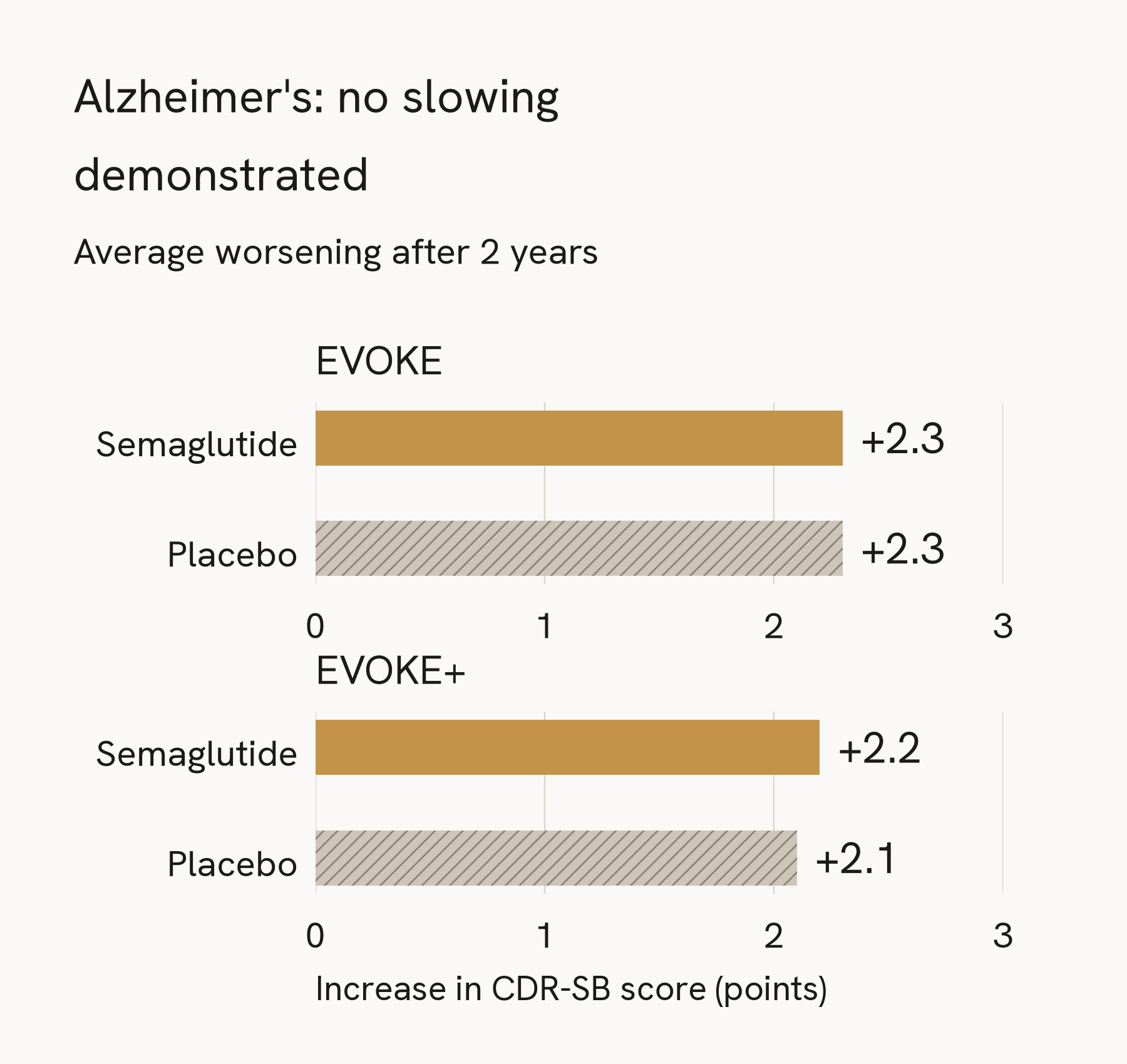
3,808 people across 40 countries. All had early-stage Alzheimer's. They received semaglutide tablets or a placebo, a tablet without an active drug.
After 2 years, the trials showed no slowing of the disease. The results were published in The Lancet in 2026.[2]
So why are researchers still interested?
The brain also depends on the body's health
Diabetes, high blood pressure and obesity in midlife are among the risk factors for dementia.[3]
Semaglutide affects body weight, blood sugar and some markers of inflammation.
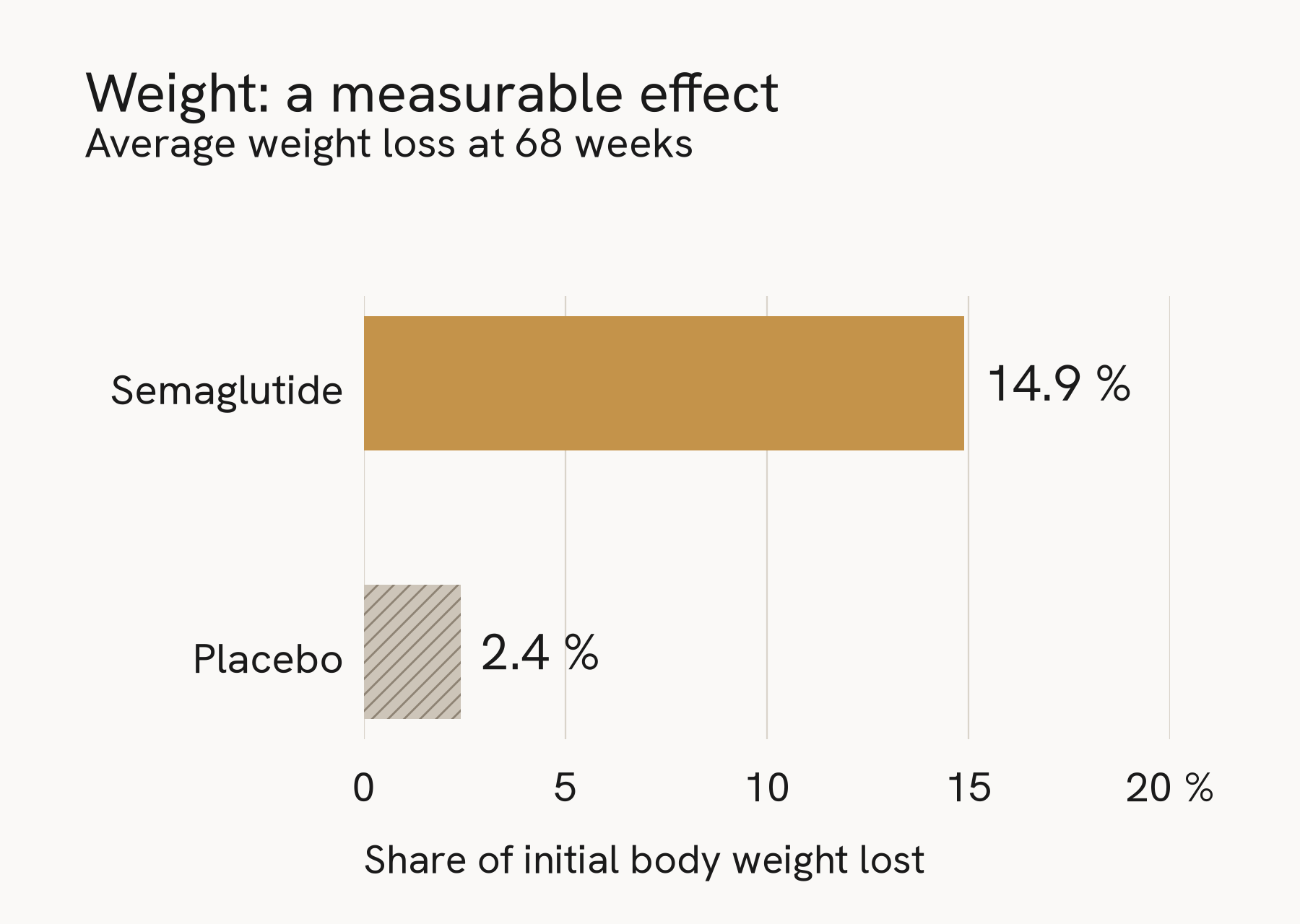
Trials in obesity or diabetes, using therapeutic doses, have measured concrete changes:
- Weight: about 15% lost on average over 16 months, compared with 2.4% on placebo. STEP1 enrolled adults with overweight or obesity, without diabetes.[4]
- Blood sugar: about 3 in 4 people reached the study's diabetes-control target, compared with 1 in 4 on placebo, over 7 months. SUSTAIN1 measured average blood sugar.[5]
- Inflammation: a blood marker was 44% lower than on placebo after 16 months in STEP1. That marker is CRP, not a measure of all inflammation in the body.[6]
These figures come from different trials, with different participants and doses. They don't measure Alzheimer's risk.
Could prevention start before symptoms?
This is where prevention gets interesting. EVOKE enrolled people who already had Alzheimer's. Could improving these factors earlier also help protect the brain before the disease appears?
That's the question I find fascinating. The same hope of acting early also appears among some people exploring GLP-1 microdosing for longevity.[7]
But the trials cited here didn't test microdosing. That practice has not demonstrated any preventive effect against Alzheimer's.
Researchers still need to establish whether a preventive benefit exists and how it would work: directly in the brain, through metabolic effects, or both.
For now, semaglutide did not slow Alzheimer's in EVOKE. Prevention remains a hypothesis to test.
Continue the conversation
We discuss this research and daily life on GLP-1 treatment in the Ouros community. To join by invitation, email me to request an invitation.
Sources
- Wang et al. (2024), semaglutide and first Alzheimer's diagnoses in people with diabetes.
- EVOKE and EVOKE+, The Lancet (2026), trials in early-stage Alzheimer's.
- WHO, dementia and risk factors.
- STEP1 (2021), weight loss in adults with overweight or obesity, without diabetes.
- SUSTAIN1 (2017) and detailed results in the official product information. Target: HbA1c, a measure of average blood sugar, below 7%.
- Verma et al. (2022), semaglutide and CRP, analyses of STEP1 to STEP3.
- Ipsos Health Service Report (2025), discussions of microdosing and longevity. This describes a trend, not evidence of efficacy.
General information, not medical advice. Discuss any treatment decision with your doctor.