
Peptides and hair... yeah. You hear a lot about it.
Between regrowth promises and shedding stories, it is hard to know what is real.
So what does the science actually say?
Peptides are already in hair products
You already see them in mainstream products from brands like The Ordinary, Typology, or Aroma-Zone.
The names that come up most often:
- Acetyl Tetrapeptide-3
- Biotinoyl Tripeptide-1
- Copper Tripeptide-1
But that is not the same topic at all as an injected peptide, the kind your influencers talk about.
The name that keeps coming up: GHK-Cu
On Reddit or TikTok, one name keeps coming back: GHK-Cu.
It is a copper peptide. People talk about it for skin, collagen, and the whole glow angle.
And for hair, many present it as a peptide that may support growth.
On social media, the feedback is often strong: more density, regrowth, baby hairs, thicker-looking hair.
But on the science side, the evidence is much more modest.
Peptides and hair shedding
Myth or reality?
Under reta or other GLP-1s, some people report heavier hair shedding.
But the cause is probably not the peptide itself.
The real issue is often:
- rapid weight loss
- calorie deficit
- metabolic stress
That can trigger temporary shedding called telogen effluvium.
What the science says today
On the shedding side: studies do confirm an increased risk on GLP-1s. A systematic review of 24 studies, and a cohort published in 2026.
And the one that produces the most weight loss is also the one most frequently linked to shedding. In the 2025 review, tirzepatide comes up most often. That is the strongest argument for weight loss being the cause, rather than the molecule.
My own case, on reta: 4.2 kg in 2 weeks, and more shedding than usual.
I stopped reta. The shedding stopped. Today there is no lasting impact on my hair.
And if it happens, it grows back
Shedding starts two to three months after the trigger.
It lasts three to six months.
Then hair grows back in the affected areas.
It is not a permanent loss. It is a delay.
So, does a peptide regrow hair?
Yes, studies do show positive effects. Just not on the peptide everyone talks about.
A penta-peptide, Gly-Pro-Ile-Gly-Ser, was tested in 22 men over four months, double-blind against placebo. The proportion of thick hair rose significantly, vellus hair fell, and blinded reviewers graded the appearance of baldness as improved on photographs.
A second randomised placebo-controlled study shows a benefit of biomimetic peptides in alopecia areata. But alopecia areata is an autoimmune condition: it is not the same subject as ordinary pattern hair loss.
GHK-Cu, on the other hand, has no human trial for hair. What exists is a 2007 study on isolated follicles in a lab. The peptide everyone talks about is the one with the least evidence.
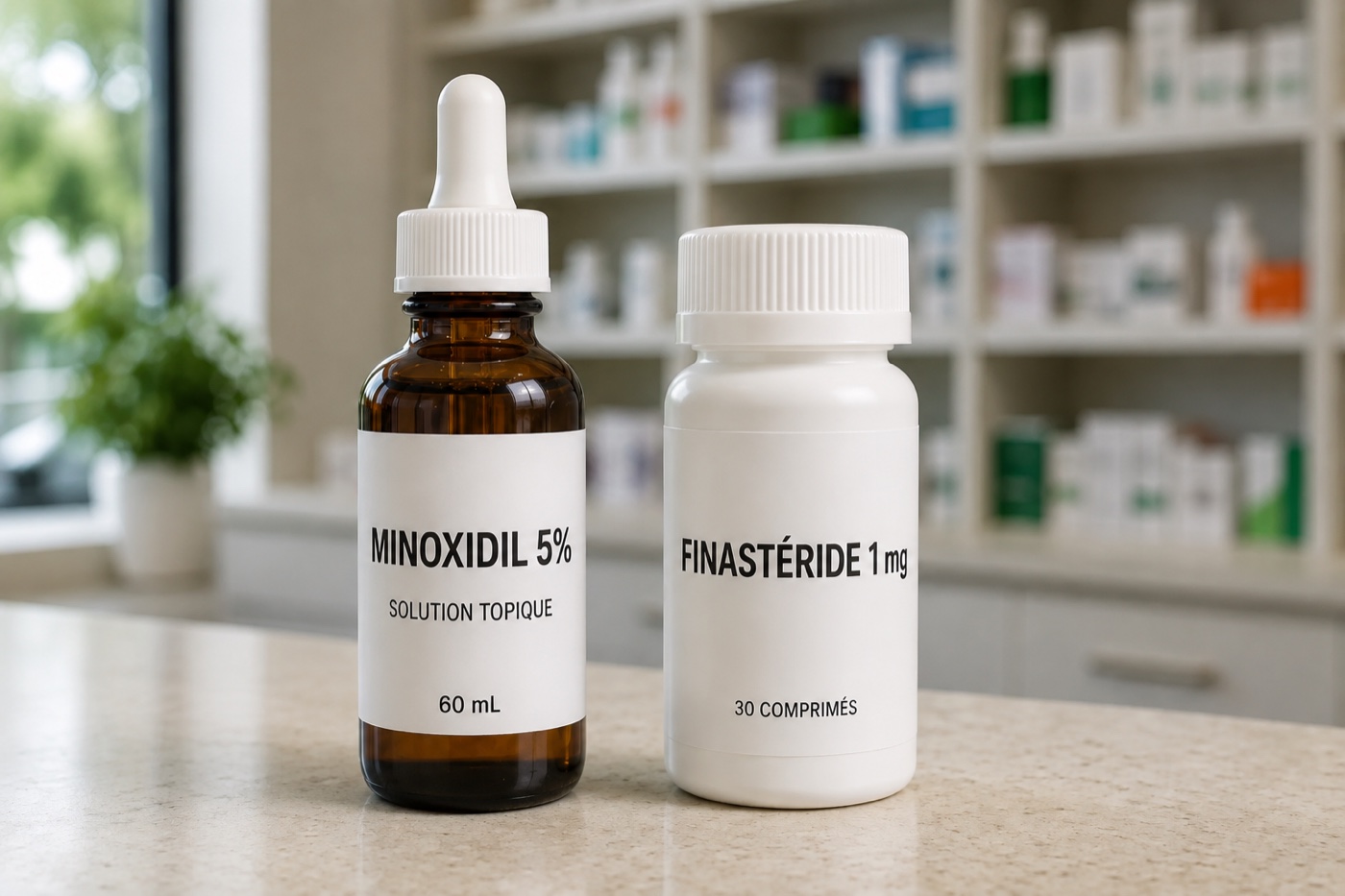
And the only two proven at scale remain minoxidil and finasteride. Nothing new since 1997.
The simplest rule may be this: when it comes to hair, the promises usually move faster than the evidence.
And when a peptide starts to look like it does everything, that is usually the moment to slow down.
Until the next edition, take care.
Sources
- 2025 systematic review on GLP-1s and hair loss, 24 studies included: telogen effluvium is the dominant subtype, and it tracks the magnitude of weight loss. PMC13100445
- TriNetX cohort study, Journal of the American Academy of Dermatology, 2026: risk of new-onset hair loss with semaglutide and tirzepatide. PMC12997224
- Cleveland Clinic, telogen effluvium: onset, duration and regrowth. clevelandclinic.org
- Iwabuchi et al., Journal of Cosmetic Dermatology, 2016: the penta-peptide Gly-Pro-Ile-Gly-Ser increases the proportion of thick hair in 22 men, double-blind against placebo. PMID 27030543
- Rinaldi et al., Journal of Dermatological Treatment, 2019: randomised placebo-controlled trial of biomimetic peptides in alopecia areata. PMID 30513014
- Pyo et al., Archives of Pharmacal Research, 2007: effect of a tripeptide-copper complex on human hair growth, in vitro. PMID 17703734
- GHK-Cu review, International Journal of Molecular Sciences: most of the hair data remains in vitro and mechanistic. PMC6073405
Personal experimentation, not medical advice. Retatrutide and GHK-Cu are not approved medicines in Europe. Talk to a doctor.