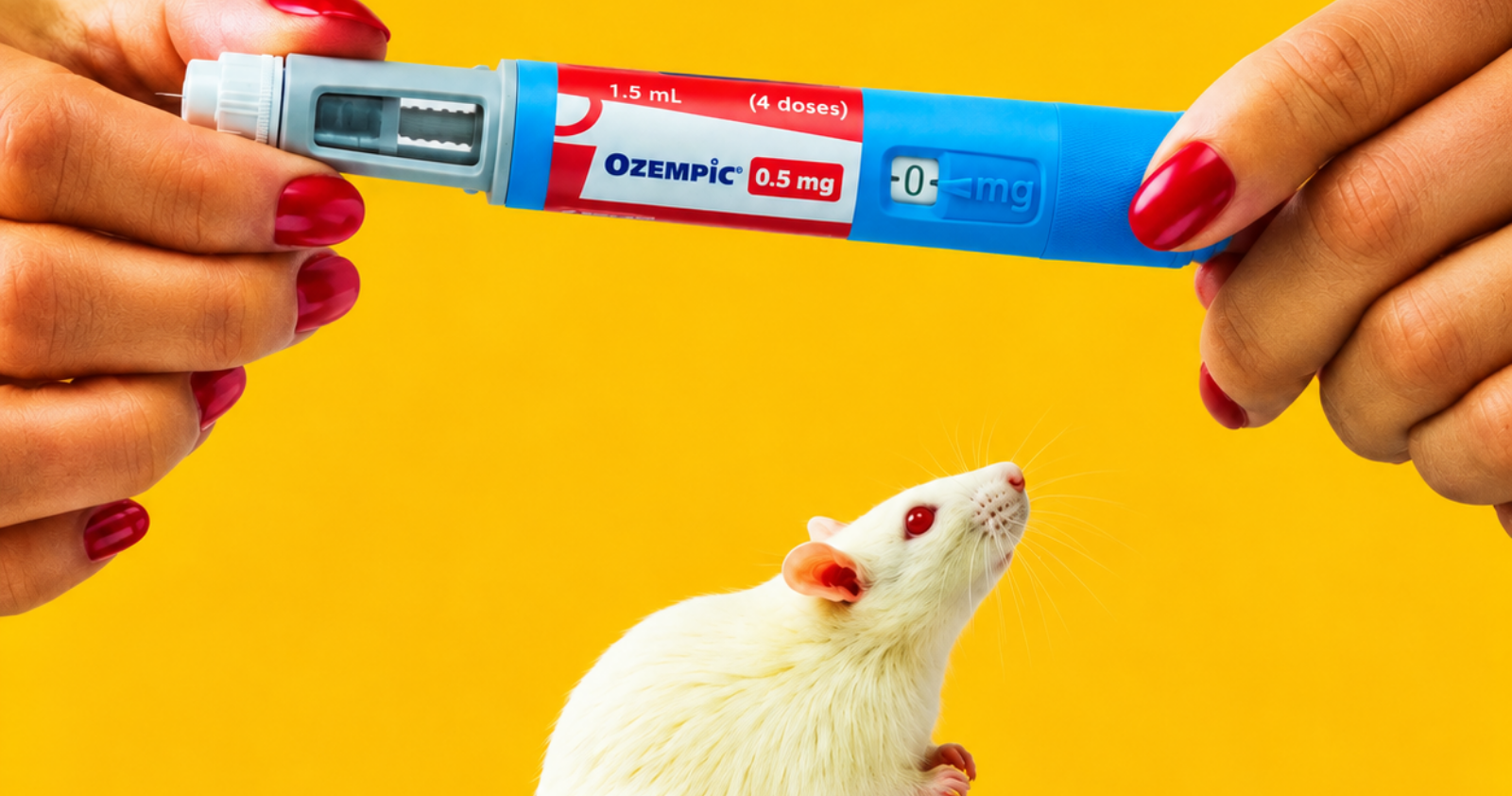
On September 2, Nature published a study that went around social media in 48 hours.
Mice treated with semaglutide, the molecule behind Ozempic and Wegovy, lived longer than untreated mice.[1]
It is the first signal of its kind for a molecule already sitting in pharmacies.
The protocol
Healthy female mice, 20 months old.
That is late. Roughly a human in their sixties.
Daily semaglutide injection, continued to the end of their lives.[1]
The result
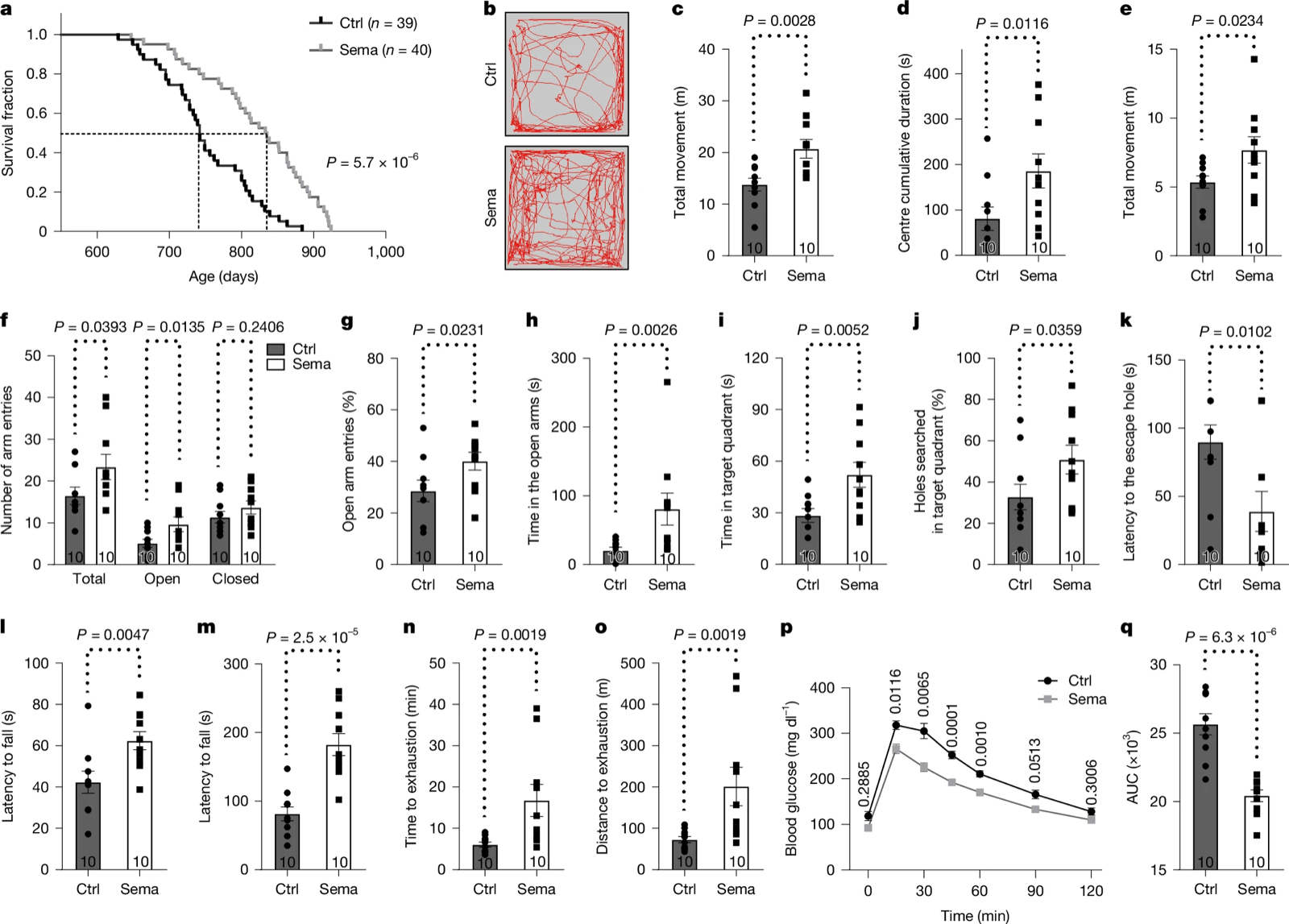
Median lifespan: 834 days against 742.
That is 92 days, or 12%.[1]
The detail that makes the number solid: causes of death were the same in both groups.
Semaglutide did not remove one disease. It pushed death back on several fronts at once.
That is the signature of a general slowdown of ageing, not a targeted treatment.[1]
The benefits
They did not just live longer. They aged better.[1]
- More movement and more exploration. An old mouse hugs the walls; these went back to the middle.
- Better spatial memory.
- Better coordination, more strength, more endurance.
- Better glucose handling.
- Weight loss that came from fat: percentage lean mass went up, not down.
They also cut their own intake by 24%. Against mice held at the same calorie level, they match on strength and endurance, and do better on exploration, memory and glucose.[1]
So the effect is not just eating less. And it comes without the permanent hunger of strict dieting.[3]
This is not an isolated signal
The study lands after several years of results pointing the same way. All of them on a GLP-1 treatment.
- SELECT: 20% fewer major cardiovascular events, in people with overweight and no diabetes. Semaglutide 2.4 mg weekly, the Wegovy dose.[4]
- FLOW: less kidney damage and lower mortality in type 2 diabetes. Semaglutide 1 mg weekly, the Ozempic dose.[5]
- And trials under way on the liver and on Alzheimer's, again with semaglutide.[1]
Every time, the benefit runs ahead of what weight loss alone would explain.
What we do not know yet
These are mice. Females only.[1]
The mechanism behind the extra effect has not been identified.[2]
And nothing is proven in humans on longevity. Trials are starting; it will take years.[2]
What I take from it
"Ozempic makes you live longer" runs too fast. But the opposite would be just as wrong.
It is the first time a molecule already prescribed to millions reproduces, in a mammal, what only food deprivation could do.
I increasingly think we are looking at a class of molecules that goes far beyond weight loss. GLP-1, or whatever comes after it.
Sources
- Feng, Y. et al., Late-life semaglutide treatment slows ageing and extends lifespan in female mice, Nature, September 2, 2026.
- Lenharo, M., Can GLP-1 drugs slow ageing? Mouse study shows promise, Nature News, September 2, 2026.
- Fontana, L., Partridge, L. & Longo, V. D., Extending healthy life span: from yeast to humans, Science, 2010.
- Lincoff, A. M. et al., Semaglutide and cardiovascular outcomes in obesity without diabetes (SELECT trial), New England Journal of Medicine, 2023.
- Perkovic, V. et al., Effects of semaglutide on chronic kidney disease in patients with type 2 diabetes (FLOW trial), New England Journal of Medicine, 2024.
General information, not medical advice. This study was done in mice and does not justify any treatment decision.